
You Can't Put the Stone Back: What Flintknapping Taught Me About Building for Survivors
Five mistakes at the stone, and what each one taught me about building tools for people whose safety depends on getting it right.
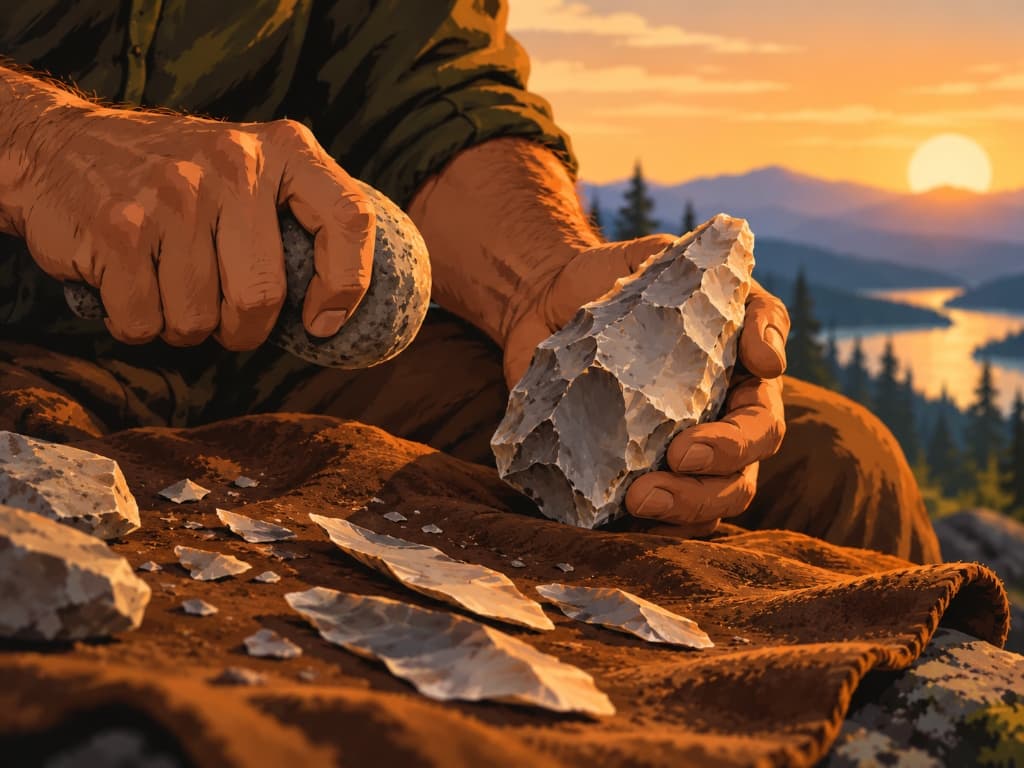
I've been flintknapping for only about a year longer than I've been writing code. It's a strange pairing. One is among the oldest technologies our ancestors left behind, a craft whose earliest traces go back more than two and a half million years. The other involves AI, one of the newest and most consequential technologies we've built.
I assumed they had nothing in common. They turned out to teach me the same lessons.
Early on, before I knew what I was doing, I tried to make arrowheads. My first attempt used a beautiful piece of Georgetown chert I found in an irrigation ditch at Barton Springs. I didn't yet know how to remove the thinning flakes that turn a thick piece of stone into a flat, sharp point, so it ended up looking like a tiny, tall almond. I've made almost every beginner mistake since, and those mistakes have taught me a surprising amount about my other work: building and evaluating technology for survivors of family violence and the advocates who support them.
The core lesson is simple. Knapping is subtractive. Every flake removes stone you can't put back. A knapper can't undo a bad removal, so the craft rewards patience, attention, and restraint.
Technology usually works differently. The industry culture of shipping fast and fixing later assumes most mistakes can be walked back. In survivor safety, many can't. A disclosed location, a notification that reveals someone was seeking help, or data that ends up in the wrong hands can't be patched after the fact. In this work, you can't put the stone back.
Here are five mistakes I've made at the stone, and what each one taught me about building tools for people whose safety depends on getting it right.
1. Working before reading the stone
My most common mistake has been impatience. I've started working without taking time to study the contours: the ridges, angles, and edges that tell you where a flake will actually come off. The stone tells you what's possible if you look first. When I didn't look, it went where it wanted, not where I intended.
Technology for survivors fails the same way when builders skip the slow work of understanding the people who will use it. An app can work beautifully for someone who controls their own phone and still be dangerous for someone whose partner knows the passcode, shares the phone plan, manages the family cloud account, or checks the device at night. Those conditions aren't edge cases. For many survivors, they are the material.
Reading the stone means listening to survivors and advocates before designing anything, and building from their realities rather than from an imagined typical user.
Protect Lead, a tool I built to help draft protective order applications in Texas, started this way. A friend and colleague, an experienced advocate, went through the process of trying to submit a protective order and found it far harder than it should have been. If the process is that difficult for someone who knows the system, it's harder still for a survivor navigating it alone. Building from her experience, rather than from how the process looks on paper, shaped what the tool needed to do.
2. The wrong tool for the stone
Knappers use different tools for different work: hammerstones and billets of different materials and masses. I've used the wrong one for the stone or the task more times than I can count. Too heavy and you lose control. Too light and nothing happens. The tool has to match the work.
In technology, it's tempting to reach for the most powerful option available, which right now often means AI. But sometimes a survivor is better served by a simple web page, a clear phone number, or a well-trained advocate than by a chatbot. A lighter tool can be more precise and leave less behind. The question isn't what's most impressive. It's what fits the work.
3. Too much, too fast
I've broken pieces in half by using more force than the stone needed. One careless removal can undo hours of careful work.
The technology version is overreach: an app that tries to do everything, or a powerful system deployed where a lighter intervention would do. In most software, an overbuilt feature is an inconvenience. In survivor safety, a tool that fails can leave someone worse off at the exact moment they relied on it. Restraint isn't timidity. It's matching effort to the task.
4. The edge I couldn't get past
Every knapper has an old nemesis. Mine is concrete: a chunky, chalky patch in the stone that can show up on an edge. Good knapping stone is fine-grained and uniform, so energy travels through it cleanly and flakes come away smoothly. Concrete doesn't carry energy that way. When it appears on an edge, there's no longer a good platform, the small surface where the next flake can start, and the piece can't be thinned any further. Trying the same spot again doesn't help. I either have to find a new angle entirely or accept that the piece is done.
Software can have its own concrete. When a design is flawed at the foundation, effort stops carrying through: there's no good place left to add what's missing, and each patch aimed at the symptom can make things worse. Privacy and safety features bolted onto a product that wasn't built for survivors often work like this. Sometimes the right answer is a different approach. Sometimes it's acknowledging that a tool can't be made safe for this use, and saying so.
5. Making arrowheads before I was ready
Back to that little almond of Georgetown chert. Arrowheads are fine, delicate work, and I attempted them before I had the fundamentals. What I made looked like a start from a distance, but it could never become the tool I intended.
I see the same pattern in technology built for survivors, and with only about a year of coding behind me, I've been that beginner myself. Well-intentioned builders, often moved by a personal connection to the issue, create polished-looking safety apps without grounding in how abuse and tech-enabled control actually work. The intent is real. But a finished-looking tool isn't the same as a safe one, and survivors are the ones who absorb the difference.
This is more pressing now that AI coding tools let almost anyone produce a finished-looking application quickly. The stone tells you immediately when you've made a mistake. AI-generated software often doesn't. I'll write about my own experience with that in Part 2.
What the stone keeps teaching
Two lessons aren't beginner mistakes. They're things the craft teaches every time.
Debitage
Knapping produces far more waste than tool. Those flakes are sharp, and they tell a story. Archaeologists can reconstruct what happened at a site from the debris alone.
Digital tools leave debitage too: browser history, notifications, cached files, cloud backups, logs, and records held by third-party services. Someone who wants to know whether a survivor has been seeking help can reconstruct a lot from what a tool leaves behind. The quick-exit buttons on family violence websites exist because of this. Every tool built for survivors has to be judged by its leftovers, not just by what it's meant to do.
Tools don't choose their users
A well-made tool works the same for whoever picks it up. Technology built to keep people safe, such as location sharing, family-tracking apps, and monitoring software, has repeatedly been turned into a means of control. Any tool meant for survivors has to be tested by imagining the person causing harm as a user and asking what they could do with it.
Who controls the tools
Knappers have always depended on access to good stone and good tools. Today, organizations serving survivors depend on a small number of technology providers whose terms, data practices, and products can change without notice. That dependence is worth naming. The more survivors and advocates shape the tools meant for them, as co-designers with real authority rather than test subjects, the more likely those tools are to fit the hands that use them.
Before the next flake
When I evaluate a tool meant for survivors, the questions I keep returning to sound a lot like the ones I ask at the stone:
- Was it shaped by the people who will use it?
- What harm could it cause that can't be undone?
- What does it leave behind?
- How could it be turned against the person it's meant to help?
- Is it the right tool for the work, or just the most powerful one?
I came to one of humanity's oldest technologies and one of its newest at almost the same time. The stone has made me slower, more careful, and humbler about how much I understand before I begin. In work where you can't put the stone back, that's the discipline I want to bring to the newest tools too.