

Technology review for survivor-serving organizations
Survivor Tech Review
Look closely before you recommend survivor-facing technology.
Survivor Tech Review helps domestic violence advocates and coalition staff examine apps and websites using public evidence, survivor-safety review criteria, evidence-linked findings, and explicit human review. It surfaces what is known, what remains unresolved, what could matter for survivor safety, and what a reviewer should do next without certifying a product as safe.
Safety note
Survivor Tech Review is decision-support software for reviewing products and websites using public evidence. It is not safety planning, crisis response, legal advice, or a guarantee that any reviewed technology is safe. Findings are evidence for human review, not automated certifications.
- Status
- Functional build
- Rubric coverage
- 10 safety criteria
- Control boundary
- Human-approved findings
- Architecture
- Zero-persistence server
Review boundaries
Human authority and technology evaluation limits
Survivor Tech Review is decision-support software designed to structure public evidence and surface potential concerns for human review. It is not an automated safety certification system and does not replace professional advocate judgment, legal review, or direct safety planning.
Operating boundaries
OPERATIONAL BOUNDARIES- 01
Does not declare any reviewed product or website safe.
- 02
Examines public-facing product information, passive technical signals, and research, not internal source code or backend telemetry.
- 03
Relies on a human reviewer to include, exclude, flag, and finalize every finding before summary generation.
- 04
Does not store review state on application servers; review data resides in browser memory until exported by the reviewer.
- 05
Uses external AI services for structured research synthesis and bounded review queries; evidence and queries are transmitted during those operations.
Control model
AI assistance vs. human authority
Clear boundaries govern what automated evaluation does and what human reviewers decide.
Automated evaluation & AI
ASSISTIVE LAYERCollect public pages, app-store listings, and passive technical signals; screen for injection-like content
Map collected evidence against 10 survivor-safety criteria; verify citations against stored evidence
Draft technical summaries and suggest spare-device testing steps from included findings
Answer grounded queries within the bounded review knowledge base during chat interrogation
Human advocate authority
AUTHORITATIVEDefine review targets, choose depth options, and provide organizational context
Triage findings: include, exclude, or flag each item based on advocacy relevance
Edit findings, modify testing protocols, and control the final adoption recommendation
Determine organizational guidance, coalition recommendations, and survivor disclosures
Review checkpoint
Product walkthrough
Evidence-based review from public intake to multi-audience export.
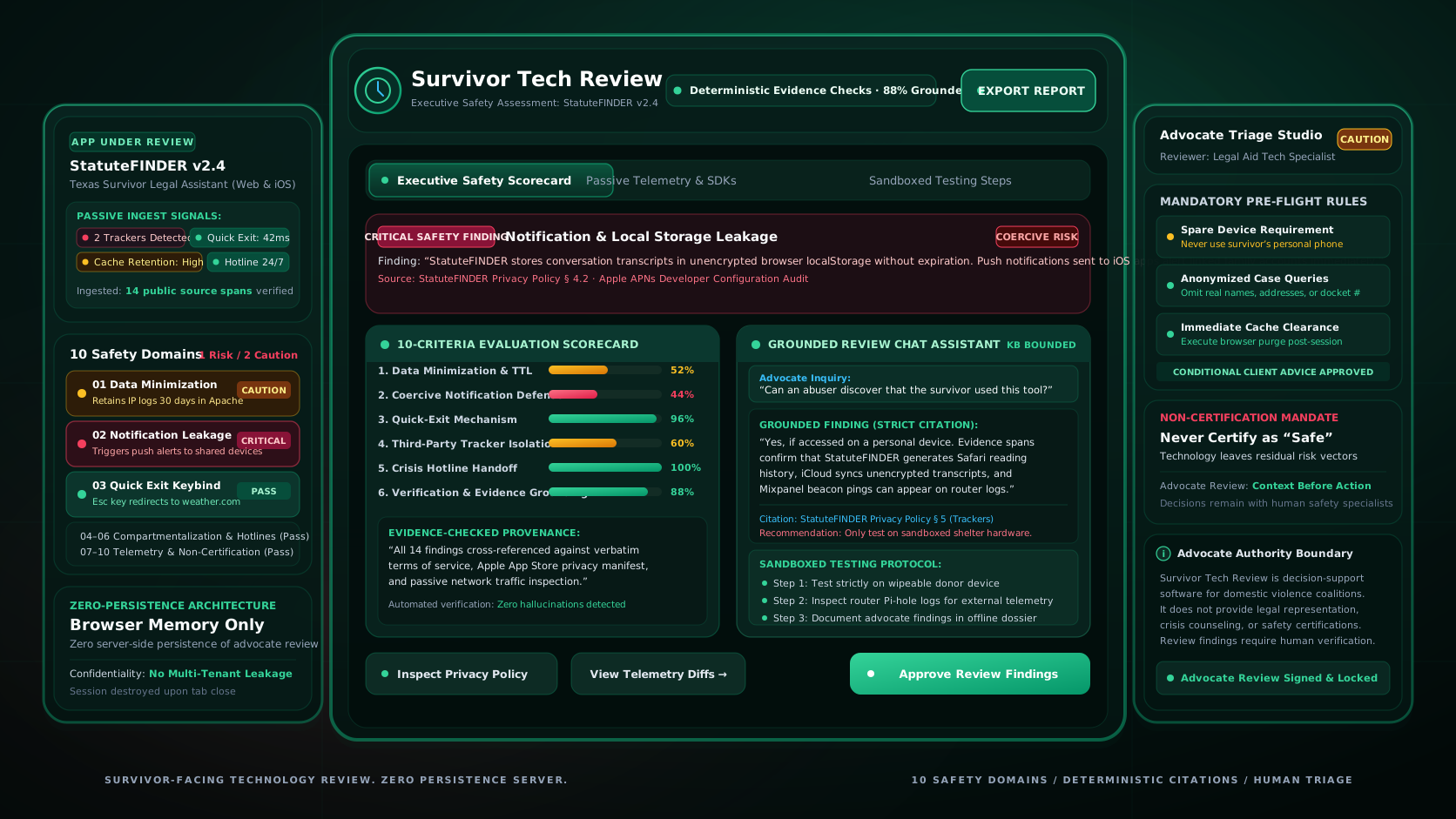
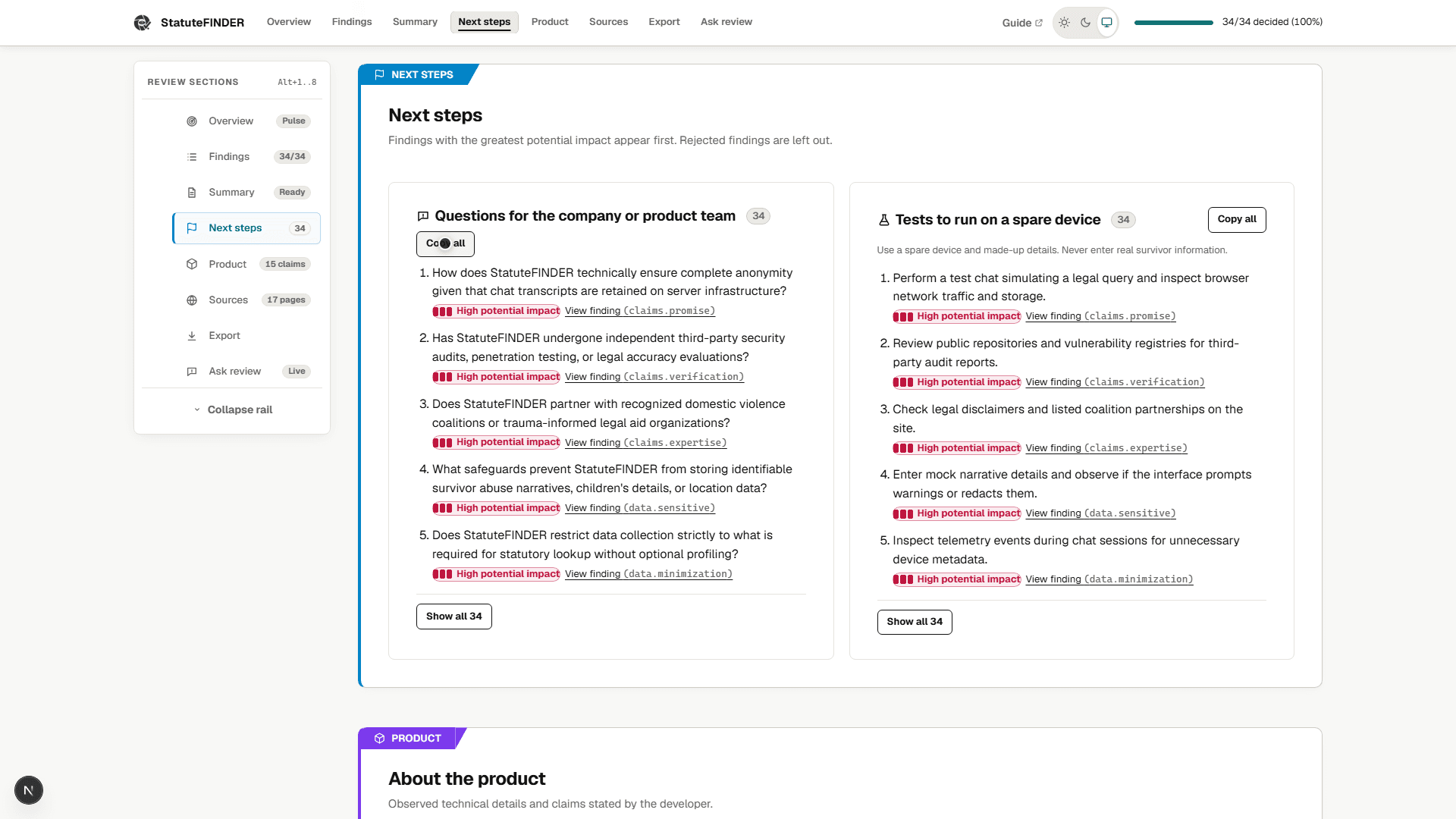
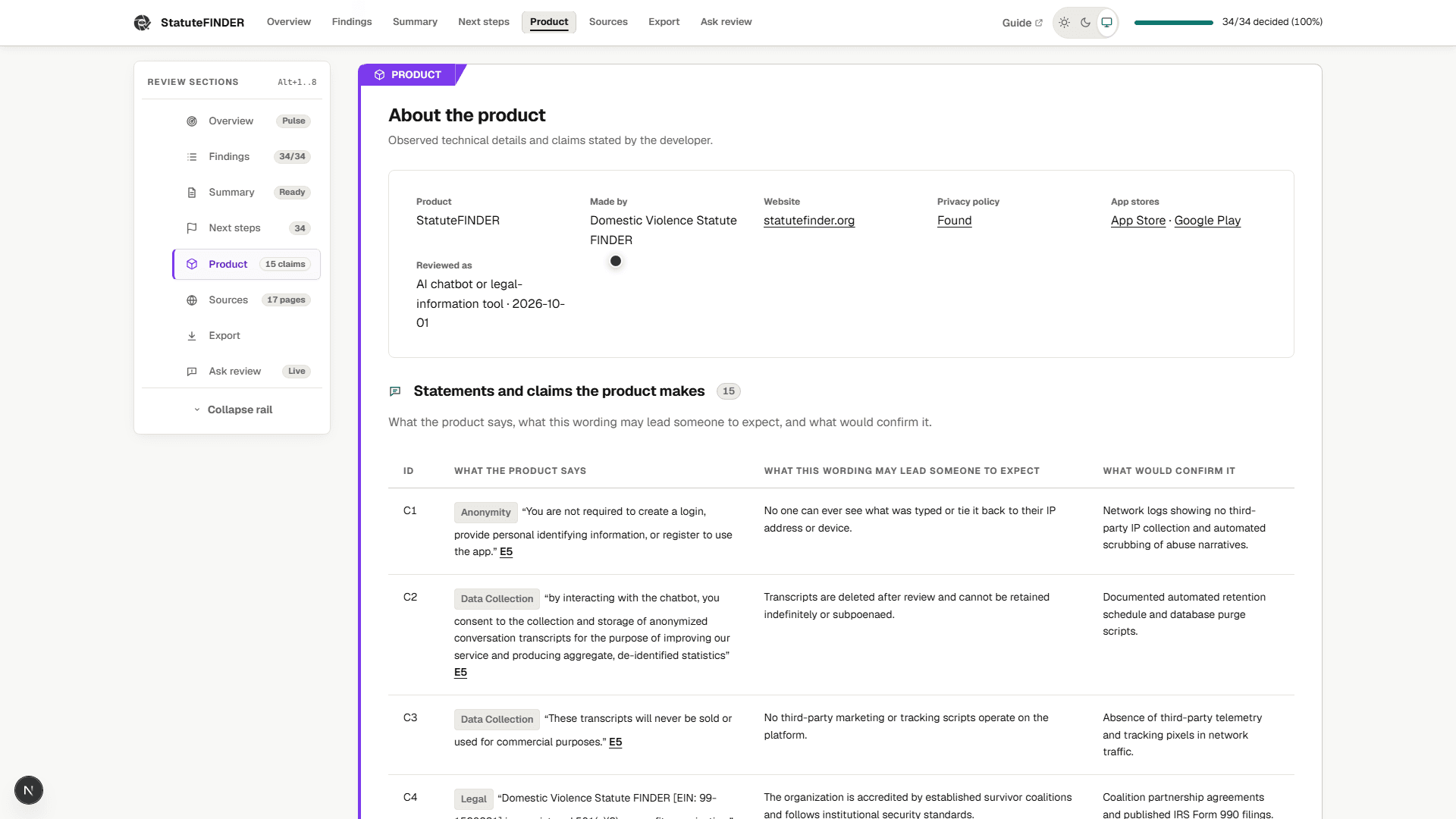
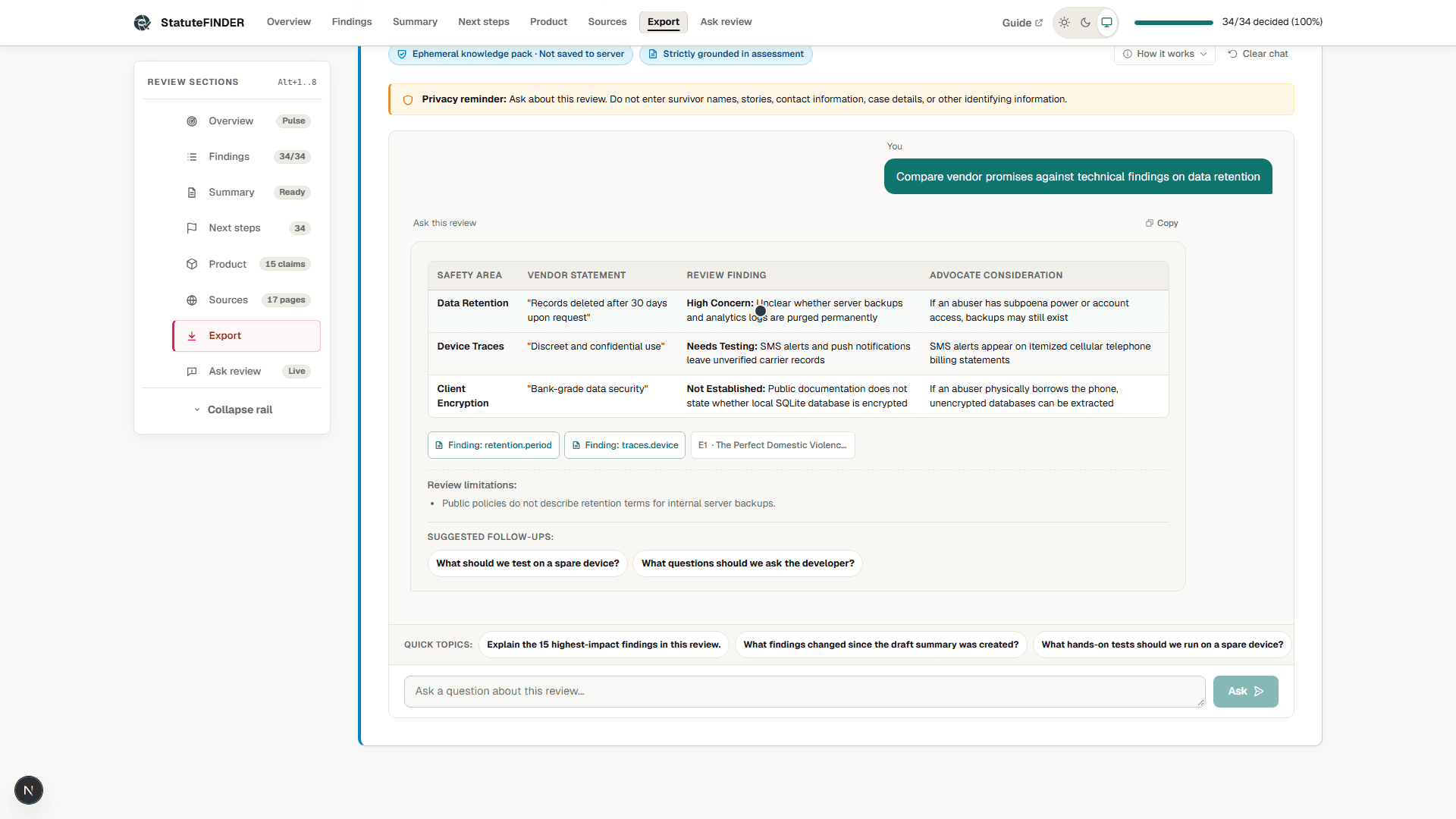
Explore key workspaces within Survivor Tech Review: executive scorecards, finding triage with deterministic citations, company questions and spare-device test protocols, and grounded review interrogation.
Representative views and review artifacts from Survivor Tech Review.
Executive review overview & safety criteria scorecard
The primary review dashboard summarizes the evaluation across 10 survivor-safety criteria, displaying finding counts, human triage status, confidence levels, and quick navigation to detailed evidence.
Full 10-section narrated assessment of StatuteFINDER demonstrating verification strength, threat matrix analysis, advocate findings triage, and executive synthesis.
Review lifecycle
End-to-end evidence gathering and advocate-controlled evaluation.
- STAGE // 01
Intake
Reviewer enters a survivor-facing app or website URL and selects evaluation depth options.
- STAGE // 02
Gather
Reads public product pages, relevant app-store material, and passive technical signals with SSRF guards.
- STAGE // 03
Research
Runs structured external research lanes using web search and retrieval tools to surface independent reporting.
- STAGE // 04
Extract & Evaluate
Catalogs product statements and evaluates evidence against versioned survivor-safety rubric criteria.
- STAGE // 05
Deterministic Verification
Verifies verbatim quotes and source references directly against stored evidence snapshots.
- STAGE // 06
Advocate Triage
Human reviewer includes, excludes, or flags each candidate finding and adjusts severity.
- STAGE // 07
Synthesize & Action
Generates company questions, spare-device testing protocols, and drafting summary only after triage.
- STAGE // 08
Decide & Export
Advocate controls the final recommendation and exports review files, handouts, or print/PDF reports.
- 01
Intake
Reviewer enters a survivor-facing app or website URL and selects evaluation depth options.
- 02
Gather
Reads public product pages, relevant app-store material, and passive technical signals with SSRF guards.
- 03
Research
Runs structured external research lanes using web search and retrieval tools to surface independent reporting.
- 04
Extract & Evaluate
Catalogs product statements and evaluates evidence against versioned survivor-safety rubric criteria.
- 05
Deterministic Verification
Verifies verbatim quotes and source references directly against stored evidence snapshots.
- 06
Advocate Triage
Human reviewer includes, excludes, or flags each candidate finding and adjusts severity.
- 07
Synthesize & Action
Generates company questions, spare-device testing protocols, and drafting summary only after triage.
- 08
Decide & Export
Advocate controls the final recommendation and exports review files, handouts, or print/PDF reports.
System capabilities
Designed specifically for survivor-serving organizational diligence.
Survivor-Safety Rubric
Evaluates up to 10 domain-specific criteria including emergency quick exit, location privacy, data broker exposure, account sharing safety, notification concealment, and support resources.
Deterministic Quote Verification
Every claim is tied to an exact quote in collected public material and deterministically verified against cached text snapshots to prevent model hallucination.
Advocate-in-the-Loop Triage
Automated findings are treated strictly as candidates until an advocate includes, excludes, or flags them, maintaining human authority over all conclusions.
Spare-Device Testing Protocols
Automatically generates safe, step-by-step test instructions for testing alerts, location sharing, and account controls on burner or spare devices.
Vendor Question Generation
Formulates specific, technically precise inquiry questions for advocates to send to software vendors to clarify ambiguous privacy or safety practices.
Grounded Review Interrogation
Bounded "Ask this review" assistant answers advocate questions strictly using the verified findings and evidence from the current assessment.
Client-Side Privacy Architecture
Assessment state resides entirely in the advocate browser session memory, with no server-side database persistence of active review data.
Multi-Audience Export Suite
Produces technical review Markdown, portable review state JSON files, survivor-facing plain-language safety handouts, and print-ready PDF summaries.
Technical foundation
Defensive web collection, client-held state, and bounded synthesis.
Survivor Tech Review is engineered with Next.js 16, React 19, and TypeScript, combining defensive server-side collectors with a zero-server-persistence review state pattern. The direct collector implements strict SSRF protection and screens collected text for prompt-injection patterns before feeding analysis engines. Research synthesis integrates Anthropic models with external web-search tools, while all review triage, finding overrides, and final recommendations remain in browser memory until explicitly exported.
Technical Specifications & Architecture
SYSTEM PROFILE- 01
Direct collector implements SSRF safeguards blocking private IP ranges, link-local addresses, and loopback endpoints.
- 02
Collector records robots.txt disallow rules as observations rather than automatically halting review of public URLs.
- 03
Verbatim quotations are deterministically verified against raw collected text snapshots without model intervention.
- 04
Review state is held exclusively in client-side memory; no database or session persistence exists on the application server.
Trust boundaries
Data handling and external communication
Reviewer workspace (Client browser)
ZONE AUDIT- Active review state and triage decisions
- Advocate finding notes and overrides
- Final recommendation judgment
- Local JSON review file imports/exports
External processing (Server & APIs)
ZONE AUDIT- Defensive public web and app-store collection
- Anthropic API research synthesis & prompt execution
- External web search query execution
- Transient bounded review-chat context processing
Boundary note: Active review data is never persisted on the application server and exists only in browser memory until exported.
Who it is for
Built for advocates, coalitions, and safety technologists.
Primary users
- 01
Domestic violence advocates
evaluating survivor-facing apps or websites.
- 02
State, territorial, and tribal DV/SA coalition staff
reviewing technology recommendations.
- 03
Program managers and safety-tech leads assessing digital tools before recommending them.
- 04
Researchers and evaluators
conducting structured survivor-safety reviews of tech products.
Organizational fit
- 01
Organizations
seeking structured evidence before recommending mobile apps to clients.
- 02
Coalitions
establishing shared digital safety guidance for local programs.
- 03
Programs with capacity to conduct disciplined human triage of candidate findings.
- 04
Teams committed to treating findings as evidence for review, not safety certifications.
These descriptions outline intended operational use and do not imply formal endorsement by specific domestic violence coalitions.
Product status
Functional build with comprehensive test coverage.
Survivor Tech Review is a fully functional build with end-to-end collection, rubric evaluation, citation verification, reviewer triage, report synthesis, multi-format export, and grounded chat assistant. The codebase includes extensive automated test coverage verifying state management, quote matching, prompt assembly, and export formatting. It is currently maintained as a private evaluation build and has not been deployed to multi-tenant public infrastructure or external production environments.
Product & Operational Parameters
SPECIFICATION LEDGER- Codebase stage
- Functional build
- Automated test coverage
- 156 tests passing
- Hosting & persistence
- Zero-persistence server
- Production deployment
- Private evaluation build
Asset inventory
Software components and evaluation artifacts.
Review application source code
FULL-STACK NEXT.JS / REACT REVIEW WORKSPACE & GROUNDED CHAT ASSISTANT
Defensive collection engine
SERVER-SIDE COLLECTOR WITH SSRF GUARDS, IP FILTERING & INJECTION DEFENSE
Survivor-safety rubric engine
10-CRITERIA EVALUATION RUBRICS & DETERMINISTIC VERBATIM QUOTE VERIFICATION
Synthesis & export pipeline
STRUCTURED VENDOR INQUIRIES, SPARE-DEVICE PROTOCOLS, AND MULTI-FORMAT EXPORTS
Test & verification suite
156 AUTOMATED TESTS, COLLECTOR HARNESSES, AND TECHNICAL RUNBOOKS
Asset inventory
Software components and evaluation artifacts.

Review application source code
FULL-STACK NEXT.JS / REACT REVIEW WORKSPACE & GROUNDED CHAT ASSISTANT
Defensive collection engine
SERVER-SIDE COLLECTOR WITH SSRF GUARDS, IP FILTERING & INJECTION DEFENSE
Survivor-safety rubric engine
10-CRITERIA EVALUATION RUBRICS & DETERMINISTIC VERBATIM QUOTE VERIFICATION
Synthesis & export pipeline
STRUCTURED VENDOR INQUIRIES, SPARE-DEVICE PROTOCOLS, AND MULTI-FORMAT EXPORTS
Test & verification suite
156 AUTOMATED TESTS, COLLECTOR HARNESSES, AND TECHNICAL RUNBOOKS
Proposed Transfer Inventory & Asset Scope
VERIFIED ARTIFACTS- 01Implemented
Application & Review UI. Next.js 16 and React 19 review workspace, interactive finding triage split-pane, executive scorecard, and grounded chat assistant.
- 02Implemented
Defensive Collection Engine. Server-side HTTP collector with SSRF guards, private IP filtering, DNS rebinding mitigations, and prompt-injection screening.
- 03Implemented
Survivor-Safety Rubric Engine. Versioned 10-criteria evaluation framework and deterministic verbatim quote verification pipeline.
- 04Implemented
Synthesis & Multi-Format Export. Summary generation pipeline, vendor inquiry questions, spare-device testing protocols, and Markdown/JSON/PDF exports.
- 05Verified
Test & Verification Suite. 156 automated unit and integration tests covering collector guards, quote matching, state integrity, and report generation.
Survivor Tech Review is currently maintained as a private evaluation build with zero-server-persistence review state.
Frequently asked questions
Common questions about Survivor Tech Review.
01Does Survivor Tech Review certify that an app is safe for survivors?
No. Survivor Tech Review is an evidence-gathering and decision-support tool, not a certification authority. It helps advocates examine public evidence, identify potential safety risks, and document findings. Whether an app is safe to recommend depends on a survivor’s specific threat model, jurisdiction, and technological context.
02What information does the tool collect about an app or website?
The tool gathers publicly accessible product pages, app-store descriptions, published terms of service and privacy policies, passive technical headers, and external research citations. It does not inspect private source code, reverse-engineer binary apps, or access private databases.
03Where is review data stored when an assessment is in progress?
All review data—including collected evidence, triage decisions, advocate notes, and final recommendations—is held in browser session memory. The application server does not store assessment records. Advocates can save their work by downloading a structured JSON review file and restore it in a future session.
04How does the deterministic citation verification work?
When the analysis engine identifies a potential finding supported by a product statement, the system extracts the verbatim quote and deterministically checks it against the raw collected text snapshots. If the quote cannot be verified in the source text, it is flagged as unverified, preventing model hallucination from corrupting the review record.
05How does the grounded review assistant answer questions?
The "Ask this review" assistant is strictly bounded to the active assessment knowledge base. It can answer questions about the triaged findings, evidence sources, safety rubric criteria, and generated next steps for the reviewed app, without answering general external queries or hallucinating capabilities.
06Can the tool be used without an external AI connection?
The client-side review workspace and export engine can load, inspect, edit, and export existing JSON review files without an active AI connection. Running a new automated evaluation or using the interactive review assistant requires connection to configured language model and research APIs.


Next step
Discuss Survivor Tech Review.
Survivor Tech Review is available for full IP transfer, collaborative pilot deployment, or institutional sponsorship. Evaluation begins with an introductory discussion of operational fit, followed by confidential code and test suite inspection.
Staged Review & Diligence Path
ENGAGEMENT SEQUENCEAll inquiries route through the standard contact route to confirm operational alignment and schedule a technical walkthrough.