LAYER // 01
Tier 1: Upstream Source Records
Official OpenStates REST endpoints, Texas Legislature Online RSS feeds, and official bill draft PDFs ingested daily at 08:00 UTC.
Texas legislative decision support
Follow a scoped Texas policy record from source to advocacy preparation.
Texas Legislature Tracker is a decision-support and advocacy workspace designed to bridge the gap between official state legislative records and frontline policy advocacy. Built around a scoped candidate corpus of Texas legislation focused on survivor safety, domestic violence prevention, and justice reform, the platform ingests official data from OpenStates and Texas Legislature RSS feeds on a scheduled daily cadence.
The system enforces rigorous architectural separation: upstream state filings and companion records remain unalterable; application logic computes deterministic full-text search and similar bill recommendations without generative hallucination; advocacy teams manage private campaigns and priority tags with row-level security; and evidence-gated AI assistants prepare meeting briefs and 3-minute hearing testimony with mandatory human review.
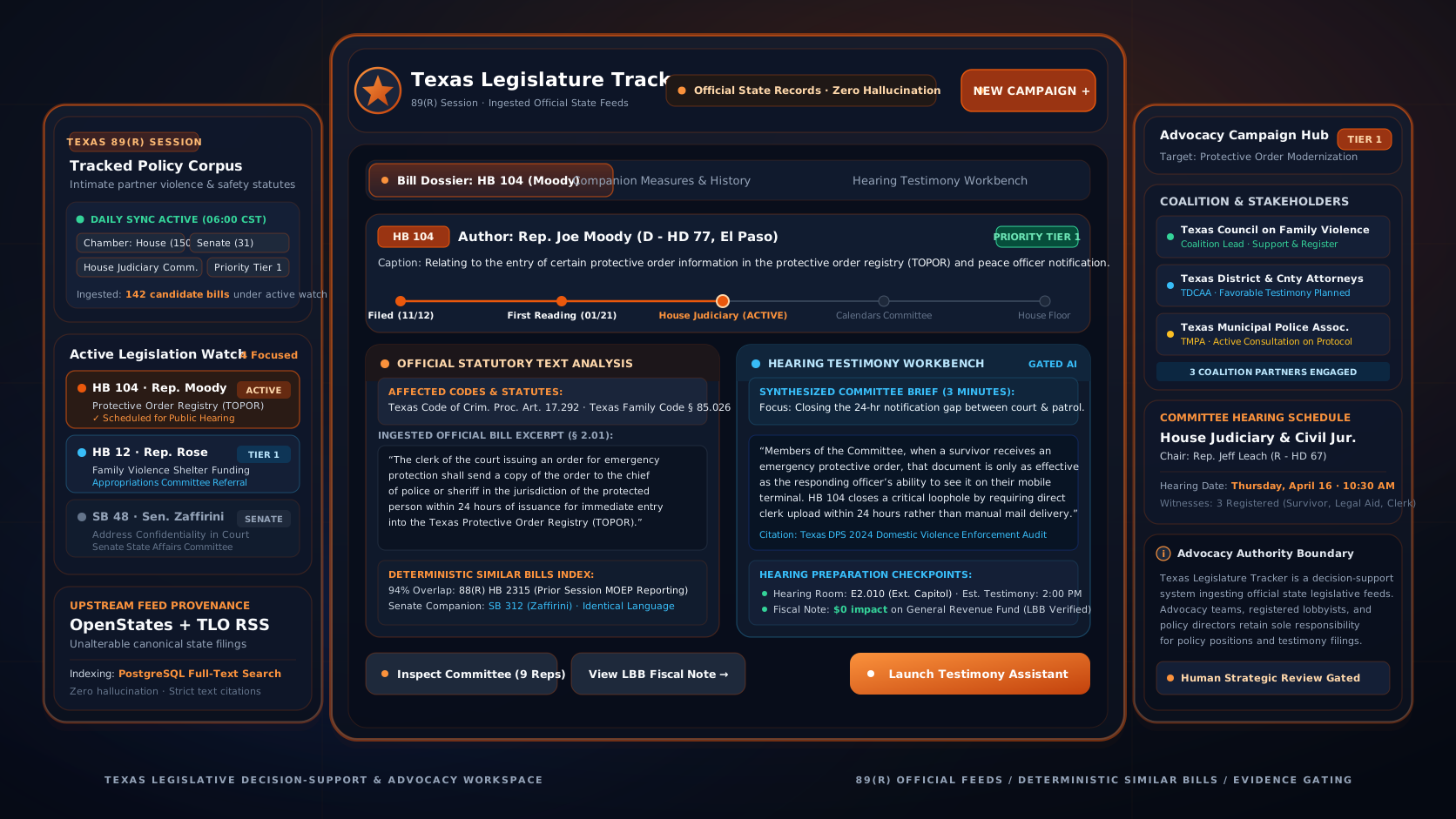
Why the workflow matters
Legislative tracking in state capitols often fails at the seams between raw bill filings, committee movements, and the advocacy work needed to respond. Public legislative portals show what was filed and when hearings occur, but offer little support for organizing campaigns, analyzing amendments, or preparing advocates for hearings on compressed timelines.
Texas Legislature Tracker bridges that gap through clear architectural separation. Official state records from OpenStates and the Texas Legislature RSS feed are ingested on a scheduled daily cadence and normalized into canonical tables. Deterministic application logic handles full-text indexing, priority relevance scoring, and keyword-based similar bill matching without generative hallucination.
On top of these verified records, policy teams manage private workspace campaigns, track key lawmakers and committee assignments, and leverage evidence-gated AI assistants to draft testimony, synthesize bill impacts, and prepare legislative meetings. Crucially, human policy judgment remains the final checkpoint for every strategic action, ensuring advocacy is strictly grounded in official legislative text.
Product walkthrough
Texas Legislature Tracker organizes legislative intelligence into five distinct phases, moving from upstream discovery to human-verified committee preparation.
Authentic UHD runtime captures from the deployed Texas Legislature Tracker application showing the complete legislative intelligence pipeline.
Ingest and filter scoped Texas policy records with deterministic relevance scoring, session selection, and full-text keyword search.

Texas Legislature Tracker bills workspace featuring multi-chamber search, policy category filters, companion tracking, and priority badges.
Functional anatomy
Every piece of data is categorized by its provenance and mutability, preventing automated or generative confusion with statutory law.
Official OpenStates REST endpoints, Texas Legislature Online RSS feeds, and official bill draft PDFs ingested daily at 08:00 UTC.
Normalized Supabase PostgreSQL tables providing a stable, point-in-time relational cache for 181 legislators, 60 committees, and candidate bills.
Algorithmic ranking, full-text search indexes, and subject taxonomy matching operating strictly within PostgreSQL without generative models.
Private, organization-scoped campaigns, custom priority classifications, and internal advocacy notes protected by Row-Level Security.
Server-managed AI workbenches providing objective bill impact summaries, meeting briefings, and 3-minute committee hearing testimony drafts.
Final human verification, advocacy strategy sign-off, committee testimony delivery, and legislative stakeholder communication.
Automated tools and AI generators never commit policy positions or publish communications without explicit human approval.
Information model & capabilities
Texas Legislature Tracker enforces strict boundaries between what the state publishes, what the application computes deterministically, and what human advocates decide.

Automated cron jobs pull updated bill filings, committee schedules, and chamber action histories every morning at 08:00 UTC.
Focuses analysis on policy areas relevant to survivor safety, family justice, and domestic violence prevention rather than noise.
Connects bills, co-authors, companion legislation, committee referrals, and legislative hearing calendars in Supabase PostgreSQL.
Fast, multi-column search indexes across bill numbers, titles, official captions, authors, subjects, and statutory revisions.
Deterministic similarity scoring based on shared subject tags, committee referrals, and keyword frequency without generative hallucinations.
Visual mapping interface connecting Texas House and Senate districts to lawmakers, demographic profiles, and local coalition partners.
Group high-priority legislation into active advocacy campaigns with custom milestones, strategic notes, and assigned team members.
Central directory of non-profit allies, advocacy organizations, and state agency contacts engaged across tracked bills.
Contextual dossiers summarizing a legislator’s sponsored bills, committee leadership roles, and relevant policy posture.
Verifies official amendment text presence before conducting analysis, explicitly refusing speculative summaries when text is absent.
Drafts structured oral testimony and written remarks adhering to strict legislative committee time limits and protocol.
Synthesizes complex bill text into objective summaries, highlighting affected Texas statutes and operational considerations.
How it works

Daily scheduled sync pulls new filings from OpenStates and Texas Legislature feeds, identifying candidate bills by policy relevance.
Review official captions, companion bills, co-authors, and legislative action history in a unified, verified dossier.
Identify relevant House and Senate committees, committee chairmen, and member voting alignments.
Organize high-priority bills into shared organizational campaigns with custom priority tags and target deadlines.
Deploy targeted AI workbenches for meeting preparation, section-by-section analysis, or testimony drafting.
Verify newly filed floor or committee amendments, with automatic refusal if official text is missing.
Policy advocates review and edit all generated briefing materials before delivering testimony or meeting with legislators.
Daily scheduled sync pulls new filings from OpenStates and Texas Legislature feeds, identifying candidate bills by policy relevance.
Review official captions, companion bills, co-authors, and legislative action history in a unified, verified dossier.
Identify relevant House and Senate committees, committee chairmen, and member voting alignments.
Organize high-priority bills into shared organizational campaigns with custom priority tags and target deadlines.
Deploy targeted AI workbenches for meeting preparation, section-by-section analysis, or testimony drafting.
Verify newly filed floor or committee amendments, with automatic refusal if official text is missing.
Policy advocates review and edit all generated briefing materials before delivering testimony or meeting with legislators.
Decision boundary & safety
In legislative advocacy, accuracy is paramount. A single hallucinated clause or misstated committee referral can derail policy credibility. Texas Legislature Tracker implements strict evidence gating and decision boundaries to ensure that official state records remain untampered and all generative drafting requires explicit human verification.

Human-AI control architecture
Every analytical feature operates within defined evidence boundaries with human sign-off.
Extracts official legislative text, action chronologies, and companion bill links from OpenStates and state RSS feeds.
Computes deterministic Similar Bills scores and full-text keyword indexing across the candidate corpus.
Checks official amendment text availability and refuses comparative analysis if full text is absent.
Drafts structured 3-minute committee hearing testimony tailored to specific legislative committee guidelines.
Generates lawmaker meeting briefing memos based on publicly sponsored bills and committee memberships.
Verifies statutory interpretations, bill priorities, and organizational positions on filed measures.
Determines whether identified companion or similar bills warrant coalition coordination or opposition.
Obtains physical floor amendments or committee substitutes from legislative clerks when digital text is delayed.
Reviews, fact-checks, edits, and personally delivers oral testimony before legislative panels.
Directs all legislative negotiations, constituent outreach, and strategic voting recommendations.
System outputs are decision-support aids designed for expert advocates. They do not constitute legal advice or automated lobbying.
Intended use
tracking family violence and justice statutes.
requiring structured, evidence-grounded policy briefing materials.
Intended audience and operational fit describe target use cases and do not imply current endorsement or formal use by specific state agencies.
Operational reality
Texas Legislature Tracker is deployed on Vercel with automated continuous synchronization. As of verified runtime check on October 6, 2026, the production deployment is healthy, matching current main commit SHA 06e0f817, maintaining 2,032 candidate bills, 181 legislators, 60 committees, and 64 legislative events with fresh data across all entities.
Architecture & infrastructure
Texas Legislature Tracker combines a modern React 19 frontend with Supabase PostgreSQL, scheduled serverless synchronization pipelines, and an evidence-gated AI assistant layer. Upstream state data is ingested through OpenStates REST APIs and Texas Legislature RSS feeds, transformed into normalized relational models, and indexed for high-performance full-text search.
React 19 & Vite: Fast, responsive client architecture with component-level state and interactive UI workbenches.
Supabase PostgreSQL: Relational storage for bills, legislators, committees, events, campaigns, and user notes, with native full-text search indexing.
Automated sync pipeline: Scheduled daily cron jobs ingesting candidate bills, chamber actions, and committee calendar updates.
Deterministic Similar Bills: Algorithmic ranking based on subject taxonomy, committee referrals, and full-text keyword frequencies.
Evidence-gated AI services: Server-side LLM integrations enforcing text availability checks before amendment analysis and testimony synthesis.
Supabase Auth & RLS: Secure authentication with row-level security protecting private user campaigns and strategic advocacy notes.

Trust & data boundary

User Workspace & Application Core
ZONE AUDITUpstream Services & AI Boundary
ZONE AUDITAssisted Analysis Outputs
ZONE AUDITUser campaign strategies and private notes are secured with row-level security and never transmitted to external AI providers without user action.
Transfer scope
REACT 19 BILL WORKSPACES, LAWMAKER PROFILES, AND CAMPAIGN COMPOSERS
SUPABASE MIGRATIONS, FULL-TEXT INDEXES, AND ROW-LEVEL SECURITY POLICIES
OPENSTATES REST EXTRACTION AND TEXAS LEGISLATURE RSS SCHEDULED INGESTION
DETERMINISTIC SIMILAR BILLS SCORING AND TAXONOMY-BASED MATCHING
TESTIMONY DRAFTING, BRIEFINGS, AND AMENDMENT ANALYSIS REQUIRING OFFICIAL TEXT
VERCEL PRODUCTION CONFIGURATION, PLAYWRIGHT E2E, AND RUNBOOKS
Transfer scope

REACT 19 BILL WORKSPACES, LAWMAKER PROFILES, AND CAMPAIGN COMPOSERS
SUPABASE MIGRATIONS, FULL-TEXT INDEXES, AND ROW-LEVEL SECURITY POLICIES
OPENSTATES REST EXTRACTION AND TEXAS LEGISLATURE RSS SCHEDULED INGESTION
DETERMINISTIC SIMILAR BILLS SCORING AND TAXONOMY-BASED MATCHING
TESTIMONY DRAFTING, BRIEFINGS, AND AMENDMENT ANALYSIS REQUIRING OFFICIAL TEXT
VERCEL PRODUCTION CONFIGURATION, PLAYWRIGHT E2E, AND RUNBOOKS
React 19 & Vite application source code
Supabase PostgreSQL schema migrations & RLS policies
OpenStates and Texas Legislature RSS ingestion pipeline
Deterministic similar bills & search algorithms
Evidence-gated AI policy analysis & testimony workbenches
Playwright E2E and Jest automated test suites
Vercel deployment configuration and operational runbooks
Frequently asked questions
No. Texas Legislature Tracker monitors a scoped candidate corpus focused on survivor safety, domestic violence prevention, criminal justice reform, and related human welfare policy areas. This curated scope ensures high relevance for advocacy coalitions rather than overwhelming teams with thousands of unrelated commercial or administrative filings.
Data synchronization runs on a scheduled daily cadence, executing at approximately 08:00 UTC. It pulls new bill drafts and action histories from OpenStates and Texas Legislature RSS feeds. It is designed for daily strategic decision support rather than real-time second-by-second floor telemetry.
No. The Similar Bills feature is entirely deterministic. It uses PostgreSQL full-text search, subject matter classification overlap, and keyword frequency matching across canonical bill records. This eliminates generative hallucination and ensures every suggested companion or related bill has a verifiable statutory connection.
The Amendment Analyzer features strict evidence gating. Before performing any comparative analysis between a bill draft and a filed amendment, the system verifies that the official amendment text is present in the database. If the official text has not yet been published by the legislative clerk, the analyzer explicitly refuses substantive comparison and notifies the user.
The system runs on standard, cost-effective infrastructure: a React 19 frontend hosted on Vercel (or any static/serverless host), a Supabase PostgreSQL instance for data storage and authentication, an OpenStates API key for bill data extraction, and an optional Gemini API key for assisted drafting workbenches.
All user campaigns, custom priority flags, and strategic notes are stored in Supabase with PostgreSQL Row-Level Security (RLS) enabled. Each organization’s advocacy strategy remains strictly private and isolated from other users and upstream synchronization jobs.
Acquisition & diligence
Texas Legislature Tracker is available for outright acquisition, licensing, or organizational sponsorship. The asset is well suited for policy institutes, statewide advocacy coalitions, legal aid foundations, or civic technology organizations seeking a proven, deployed legislative tracking and advocacy engine.
Staged Review & Diligence Path
ENGAGEMENT SEQUENCEFull software asset acquisition including application source, database migrations, and ingest pipelines.
Operational handover including Supabase architecture, Vercel deployment runbooks, and API configurations.
Technical transfer review covering ingestion routines, similarity algorithms, and prompt architecture.
All inquiries are routed through the canonical contact route for qualification, diligence review, and mutual transfer agreements.